Updated & refreshed content:
Updated & refreshed content:
Updated & refreshed content:
Updated & refreshed content:
Updated & refreshed content:
Updated & refreshed content:
Updated & refreshed content:
You ever been sitting around going “what time was it 15 hours ago from now“? You’re not alone. Whether you are planning a call to your wife or husband, finish an important project, or just realize when to wake up in the morning it is all possible with our 15 hours ago from now calculator.
” + fifteenHoursAgo.toLocaleDateString(‘en-US’, optionsDate); document.getElementById(“currentTime”).innerHTML = “Your Current Local Time:
” + now.toLocaleString(‘en-US’, { year: ‘numeric’, month: ‘short’, day: ‘numeric’, hour: ‘2-digit’, minute: ‘2-digit’, second: ‘2-digit’, hour12: true }); } updateTimes(); setInterval(updateTimes, 1000);
How to Use This Tool
This 15 hours ago time calculator is very easy to use. Here’s exactly how it works:
How to use:
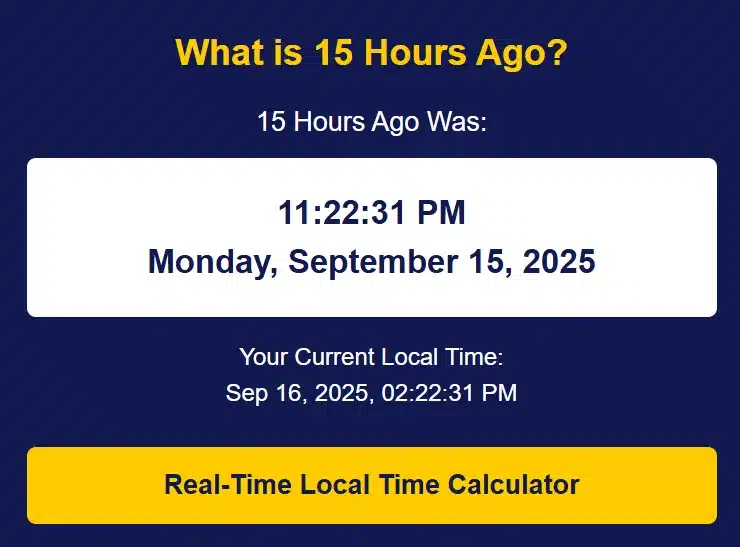
Step 1– The tool shows your local system time automatically (eg: Sep 16, 2025, 02:22:31 PM shown)
Step 2: It rapidly computes the future time from 15 hours ago.
Step 3: You will see not only the specific time (11:22:31 PM) but also the full date (Monday, September 15, 2025)
Step 4: Get to the answer straight away – no copying, manual working out_tcb required
Now consider this: how often have you attempted to do that math in your mind and become lost? This thing takes away all of that headache.
What does “15 hours ago” mean?
When you hear someone say “15 hours ago,” they’re talking about a point in time that is fifteen hours earlier than the current moment. For example, if it’s 3:00 PM right now, fifteen hours ago was midnight (12:00 AM) of the same day. Understanding this difference matters whenever you need to trace past events—whether you’re coordinating with colleagues in other time zones, logging when medication was last taken, or checking when a task was completed.
Why use a time‑ago calculator?
Manual calculations can be error‑prone because you have to account for AM/PM changes, dates rolling back a day, and even daylight‑saving time. Competitors such as oTechWorld’s date and time calculator point out that time is a precious resource and that efficient planning requires an easy way to add or subtract hours, days or weeks from the current moment. Similarly, the date‑time tool at iamrohit.in emphasises that a good calculator should let you add or subtract minutes, hours, days, weeks, months and years from the current date and time. Our 15‑hours‑ago calculator builds on these ideas and provides a fast, intuitive way to find the exact time and date fifteen hours earlier without any mental math.
Key features
- Real‑time results: The calculator instantly shows the exact time, date and number of days once you enter the hours, minutes and seconds you want to subtract, just like the Time Ago Calculator that tracks precise past times.
- Full date & time display: It presents both the clock time and the calendar date so you can see immediately when the result crosses into the previous day.
- Accurate to the second: You can enter hours, minutes and seconds; the calculation uses all three fields.
- User‑friendly interface: A simple form lets you choose the number of hours (15 by default) without having to perform manual calculations.
- No manual math: There’s no need to subtract 12‑ or 24‑hour cycles by hand—just input the value and click Calculate.
- Responsive: Works on mobile or desktop so you can check past times anywhere.
How to use the 15‑hours‑ago calculator
- Enter the number of hours, minutes and seconds. By default the tool is set to 15 hours, but you can adjust the fields if you need a different interval. The calculator from datetimecalculator.net uses three input boxes for hours, minutes and seconds, and ours follows the same pattern.
- Click “Calculate.” The tool will instantly subtract the entered time from your current system time and display the exact time, date and the number of days between now and the result.
- Read the result. You’ll see a clear output showing the clock time (e.g., 10:43 PM), the date (e.g., September 6 2025) and how many days ago that is. This makes it obvious when the calculation crosses midnight.
- Adjust for daylight saving if necessary. Most calculators—including ours—assume a standard hour. If daylight saving time changes occurred during the 15‑hour interval, you may need to add or subtract an extra hour manually.
Example times: 15 hours ago from common start times
The table below shows how subtracting fifteen hours affects several common times on 16 October 2025 (Asia/Karachi time zone). It illustrates how the result often falls on the previous day when you cross midnight.
| Current time (Oct 16 2025) | 15 hours ago |
|---|---|
| 12:00 AM | 9:00 AM on Oct 15 2025 |
| 3:00 AM | 12:00 PM on Oct 15 2025 |
| 6:00 AM | 3:00 PM on Oct 15 2025 |
| 9:00 AM | 6:00 PM on Oct 15 2025 |
| 12:00 PM | 9:00 PM on Oct 15 2025 |
| 3:00 PM | 12:00 AM on Oct 16 2025 |
| 6:00 PM | 3:00 AM on Oct 16 2025 |
| 9:00 PM | 6:00 AM on Oct 16 2025 |
Real‑world use cases
Time‑ago calculators are useful in many everyday situations:
- Healthcare: Nurses and doctors often need to know when a medication was last given. A quick subtraction of 15 hours ensures a patient doesn’t miss a dose.
- International business: When colleagues in different time zones mention that they sent a message 15 hours ago, you can quickly convert that to your local time and respond appropriately.
- Event planning: Coordinating meetings or live streams across regions requires knowing exactly what time it was 15 hours earlier, especially when working across date boundaries.
- Personal tracking: Tracking sleep cycles, workout sessions or intermittent fasting windows often involves checking what time you started or stopped an activity several hours ago.
Frequently asked questions
What time is 15 hours ago from now? The answer depends on your current local time. Subtract fifteen hours from your present clock time; if it’s after midnight, the result will fall on the previous day. For example, if it is 9:00 AM on 16 October 2025, then 15 hours ago was 6:00 PM on 15 October 2025 (see the table above).
Does the calculator account for daylight saving time? Like most online tools, it assumes a standard 60‑minute hour. If a daylight‑saving shift occurs within the 15‑hour window, adjust the result accordingly.
Can I use this calculator for other intervals? Yes. While this page focuses on a 15‑hour difference, the same tool can calculate any number of hours, minutes and seconds ago or in the future. Other date‑time tools can add or subtract minutes, hours, days, weeks, months and years.
Is it accurate to the second? Yes. As the Time Ago Calculator describes, you can input hours, minutes and seconds and the result will reflect the exact time, date and day difference.
Related tools
If you need to calculate different intervals, try our other utilities:
- Date Calculator– Add or subtract days and see future or past dates.
- Hours‑from‑now calculator – Find out what time it will be after a set number of hours.
- Time zone converter – Convert between different time zones when scheduling calls or events.
Check out latest updates & share!
Check out latest updates & share!
Check out latest updates & share!
Check out latest updates & share!
Check out latest updates & share!
Check out latest updates & share!
Check out latest updates & share!