Updated & refreshed content:
Contact Lens Vertex Calculator
If you’re switching from glasses to contacts, you might be surprised to learn that your spectacle power and contact lens power are not the same. This is where vertex distance comes into play. The contact lens vertex calculator is a tool that converts your spectacle power to contact lens power, accurately and in minutes.
Now think about it — the distance between your eye and the lens is about 12mm, but a contact lens sits directly on your eye. This distance makes a difference in lens power, especially if your power is high.
Key Features
Spectacle power input: Positive or negative, any power can be entered
• Original vertex distance: Usually 12mm
• New vertex distance: 0mm for contact lens
• Automatic rounding: Answer is rounded to 0.25 D (like contact lens powers)
• Instant calculation: Instant result, no waiting
• Professional accuracy: Based on formulas from eye care professionals
How to Use This Tool
This vertex contact lens calculator is very easy to use. Let’s see step by step:
Step 1: First, enter your spectacle power in the “Spectacle Power (D)” box. For example, -6.75 or +4.50
Step 2: In “Original Vertex Distance (mm)” it is usually 12mm (this is the standard distance between the lens and the eye)
Step 3: In “New Vertex Distance (mm)” enter 0 because the contact lens is directly on the eye
Step 4: Tick the checkbox if you want the result to be rounded to 0.25 D (this is recommended)
Step 5: That’s it! Your “Converted Contact Power” will immediately appear in the yellow box below
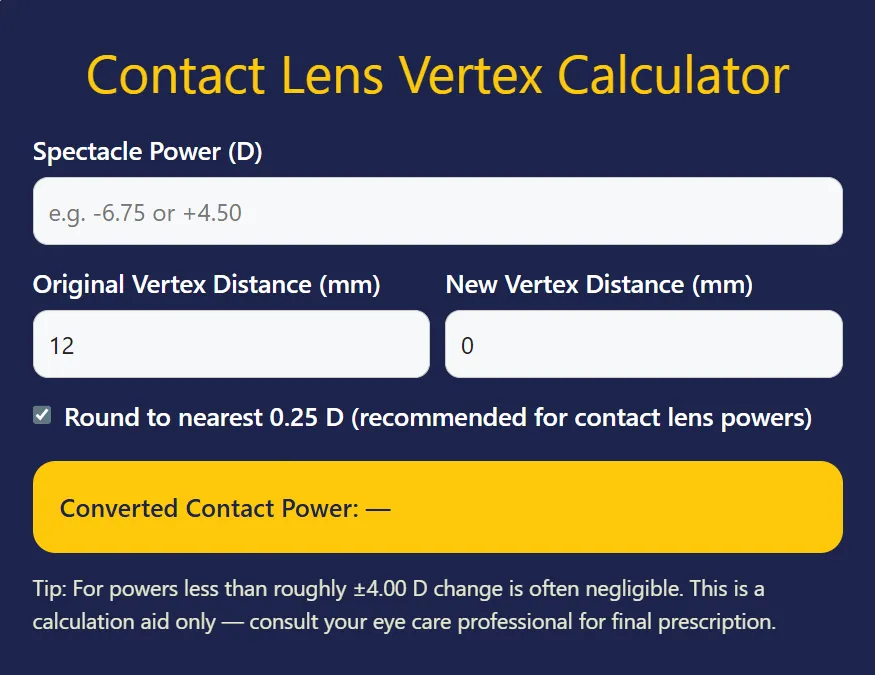
You would think this would be a complicated process, but it actually only takes a few seconds
Why Use This Tool
I have seen many contact lens calculator tools, but this tool is different because:
1. Professional-Grade Accuracy
It uses the same contact lens vertex formula that optometrists use. No guesswork, just mathematical precision.
2. User-Friendly Interface
Other tools give you complicated options and confusing layouts. This vertex calculator contact lens is very simple — only the information that is necessary.
3. Automatic Rounding Feature
In real life, contact lenses come in specific powers (0.25 D steps). This tool automatically gives you a practical answer.
4. Free & Instant
No registration, no payment. You too should try it right now — it is absolutely free.
I remember when I first thought about getting contact lenses, the optician told me that my lens power would be different from my glasses. At the time, the concept seemed confusing, but when I used contact lens calculator vertex, everything became clear.
Use Cases
Optometry Students
Those studying optometry need to practice vertex distance calculations. This tool is a perfect learning aid.
Contact Lens Beginners
First-time contact lens wearers get an understanding of why their lens powers are different.
Online Lens Shoppers
If you are ordering contact lenses online and only have a spectacle prescription, this vertex contact lens calculator will help you calculate the correct power.
Eye Care Professionals
Optometrists also find this tool handy for quick verification.
People with High Power
Vertex distance conversion is especially important for those with lens powers greater than ±4.00 D.
Personal Experience
Honestly speaking, when I first switched from -5.50 D spectacles to contact lenses, my optician prescribed -5.00 D contacts. I was confused — why the lower power?
Then I learned about vertex distance. The lenses are 12mm away from the eye, so a higher power is needed. When the contact lens sits directly on the eye, a slightly lower power is sufficient.
Now whenever I order new lenses, I first verify with this contact lens vertex calculator. Maybe this will make your job easier too — especially if you want prescription verification.
This tool gives me confidence that I am ordering the correct power. Because let’s face it, wearing lenses with the wrong power is not only uncomfortable but can also be harmful to the eyes.
FAQs — Frequently Asked Questions
Q1: What is a contact lens vertex calculator?
It is a mathematical tool that converts spectacle power to contact lens power, taking into account the vertex distance.
Q2: Why is vertex distance important?
Because eyeglasses are farther away from the eye (about 12mm) while contact lenses sit directly on the cornea. This distance affects the lens power.
Q3: Is it necessary to convert every spectacle power?
No. If your power is less than ±4.00 D, the difference is negligible. But conversion is necessary for higher powers.
Q4: What is the contact lens vertex formula?
The formula is: Contact Lens Power = Spectacle Power / [1 – (vertex distance × spectacle power)] But you don’t have to remember it — the tool does everything automatically.
Q5: Can this tool replace an optometrist?
Absolutely not! It is only a calculation aid. Always consult an eye care professional for the final prescription.
Q6: Why is rounding necessary?
Contact lenses are available in specific powers (0.25 D steps). Rounding gives you practical, available power.
Q7: Does it work for both positive and negative powers?
Yes! Whether you are myopic (minus power) or hyperopic (plus power), this vertex calculator contact lens gives accurate results for both.
Related Tools
• Starbucks Calorie Calculator – Find out the calories in your favorite Starbucks drinks
• Rucking Calorie Calculator – Calculate calories from rucking exercise
•anion gap calculator – For medical calculations
• contact lens vertex calculator – For vision correction
• neck injury settlement calculator – For legal purposes
• ACFT Calculator – For the Army Combat Fitness Test
• Date Calculator – Calculate dates and durations
• Debt Payoff Calculator – Plan your debts
Conclusion
Using a contact lens vertex calculator is no longer a complicated task. Whether you are a student, a professional, or simply someone who is switching from glasses to contact lenses — this tool will be helpful for you.
Remember, the vertex distance has a greater effect at higher powers. If your spectacle power is more than ±4.00 D, conversion is necessary.
Finally, I will say that this tool helps in the calculation, but always consult your eye care professional for the final decision. The health of your eyes is the most important!
So what’s the delay? Use the contact lens vertex calculator above now and find out your correct contact lens power.
Check out latest updates & share!