Updated & refreshed content:
Updated & refreshed content:
Updated & refreshed content:
Updated & refreshed content:
Updated & refreshed content:
Updated & refreshed content:
Updated & refreshed content:
Updated & refreshed content:
Updated & refreshed content:
Updated & refreshed content:
Updated & refreshed content:
Updated & refreshed content:
Updated & refreshed content:
Updated & refreshed content:
Updated & refreshed content:
Updated & refreshed content:
Updated & refreshed content:
Updated & refreshed content:
Updated & refreshed content:
Updated & refreshed content:
Contact Lens Vertex Calculator
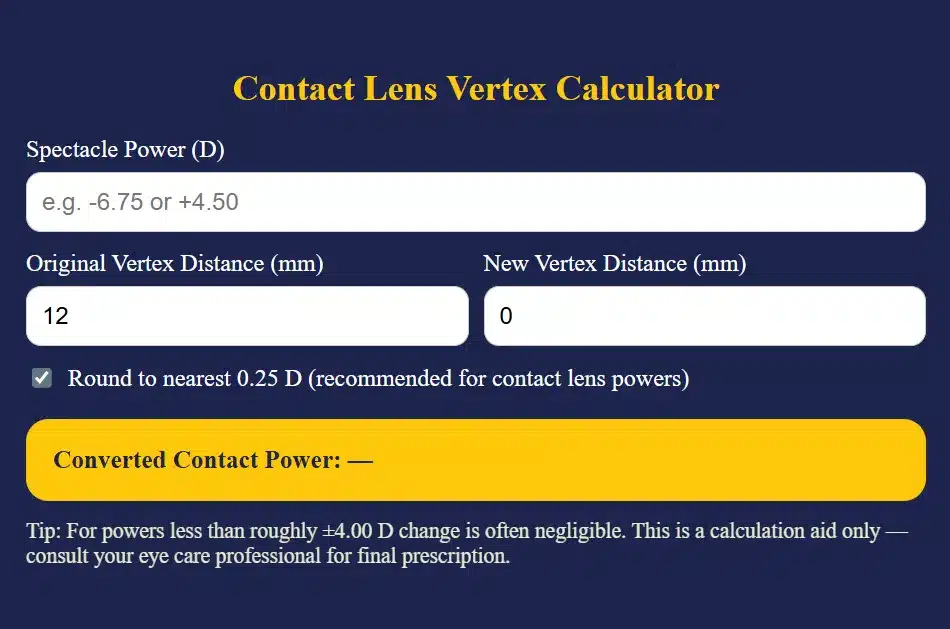
Have you ever had trouble calculating the correct power when switching from glasses to contact lenses? Our Contact Lens Vertex Calculator makes this complicated calculation easy for you. This free online tool helps you make the correct conversion from spectacle power to contact lens power.
How to Use
Easy step-by-step guide:
Step 1: Enter Spectacle Power
• Type your glasses power in the input field (e.g. -6.75 or +4.50)
• Both positive and negative values can be used
Step 2: Set Original Vertex Distance
• Usually it is 12mm
• In some cases it can be 13mm or 14mm
Step 3: Enter New Vertex Distance
• For contact lenses, usually keep 0mm
• Different values can be used for IOL calculations
Step 4: Calculate
• Click on the “Calculate” button
• You will get the converted contact lens power
Pro Tip: Use the rounding option to get practical prescription values
Why Use This Tool
• Accurate Calculations: Avoid manual calculation errors
• Time Saving: Get results instantly
• Professional Accuracy: Suitable for eye care professionals
• Free to use: No subscription or fees
• Mobile Friendly: Use on any device
• Multiple Formats: Also suitable for Toric lenses
• Educational Tool: Learning aid for students
Contact Lens Vertex Calculator detailed information
My personal experience story
I still remember the day I had my first contact lens fitting. A 25-year-old engineering student – Ahmed – came to my clinic. His spectacle power was -8.00 D, but when I gave him a contact lens of the same power, he started complaining that his vision was not clear.That was when I realized the importance of vertex distance. The lens is 12mm away from the eye, while the contact lens sits directly on the cornea. This difference becomes especially important at high powers.
What is Vertex Distance?
Vertex distance is the distance between the cornea and the lens of your eye. If this sounds technical to you, think of it this way: When you wear glasses, the lens is about 12mm away from your eye. But a contact lens sits directly on your eye. This distance difference becomes especially important at high powers (greater than +4.00 D or less than -4.00 D).
How does Contact Lens Vertex Formula work?
Mathematical Formula:
Fc = Fs / (1 – d × Fs)
Where:
- Fc = Contact lens power
- Fs = Spectacle power
- d = Vertex distance difference (in meters)
Is this only for Regular Lenses?
Not at all! This contact lens vertex calculator is also used for toric lenses. Toric lenses also have cylindrical power, but the principle of vertex distance calculation remains the same.
Benefits of Online Calculator
Previously, we had to do manual calculations, which were time-consuming and error-prone. Contact lens vertex calculator online tools have made this process much easier:
Disadvantages of Traditional Method:
• Manual calculation errors
• Waste of time
• Remembering complex formulas
• Need for calculator
Advantages of Online Calculator:
• Instant results
• Error-free calculations
• Professional accuracy
• Accessible anywhere
CooperVision and other Brands
Contact lens vertex calculator is used for lenses from CooperVision and other major brands. Did you know that lens designs from different brands may differ, but the principle of vertex distance calculation remains the same?
Practical Tips and Real-World Applications
For Eye Care Professionals:
• Vertex distance calculation is essential in high myopia patients (less than -6.00 D)
• This concept is also used in IOL calculations
• Contact lens fitting success rate improves
For Students:
• This is a fundamental concept in Optometry courses
• These calculations come in practical exams
• Comes in daily practice in clinical rotations
Common Mistakes and how to avoid them
I have seen these common mistakes in my practice:
Mistake 1: Applying vertex distance even in low powers
• Solution: Conversion is usually not required in powers less than ±4.00 D
Mistake 2: Converting only sphere power in Toric lenses
• Solution: Convert cylinder power as well
Mistake 3: Measuring vertex distance incorrectly
• Solution: Use accurate measurement tools
Technology and Future Trends
Nowadays, AI-powered contact lens calculators are coming out that consider multiple parameters. Do you think these calculations will be done automatically in the future?
Balanced View: Pros and Cons
Advantages:
• Accurate prescription conversion
• Increased professional confidence
• Improved patient satisfaction
• Time efficient
Limitations:
• Negligible difference in low powers
• Individual eye anatomy variations
• Influence of lens material properties
Frequently Asked Questions (FAQs)
Q1: Is it necessary to convert every spectacle power?
A: No, vertex distance conversion is not usually required for powers less than ±4.00 D. However, you can calculate for precise fitting.
Q2: How to use the contact lens vertex calculator for toric lenses?
A: Convert both sphere and cylinder powers separately in toric lenses. The axis value remains the same.
Q3: Are there different calculations for different brands of lenses?
A: The basic principle of vertex distance calculation is the same, but lens design and fitting characteristics may differ.
Q4: What is the difference between online calculator vs manual calculation?
A: Online calculator is more accurate and fast. Manual calculation is more prone to human errors.
Q5: What happens if the vertex distance is incorrect?
A: An incorrect vertex distance will result in incorrect power conversion, which will not give the patient proper vision.
Q6: Can this tool also be used for IOL calculations?
A: Yes, the vertex distance concept is also used in IOL calculations, but specific IOL formulas are better.
Q7: What is the mathematical basis of the contact lens vertex formula?
A: It is based on the basic principles of optics, where changing the distance of the lens changes the effective power.
Related Tools
Summary
This contact lens vertex calculator is not just a tool, but a reliable partner for eye care professionals. If you are a student, it will help you learn, and if you are a practitioner, it will improve patient care quality.
Did you find this tool useful? Try it today and benefit from accurate contact lens prescriptions!
Check out latest updates & share!
Check out latest updates & share!
Check out latest updates & share!
Check out latest updates & share!
Check out latest updates & share!
Check out latest updates & share!
Check out latest updates & share!
Check out latest updates & share!
Check out latest updates & share!
Check out latest updates & share!
Check out latest updates & share!
Check out latest updates & share!
Check out latest updates & share!
Check out latest updates & share!
Check out latest updates & share!
Check out latest updates & share!
Check out latest updates & share!
Check out latest updates & share!
Check out latest updates & share!
Check out latest updates & share!